

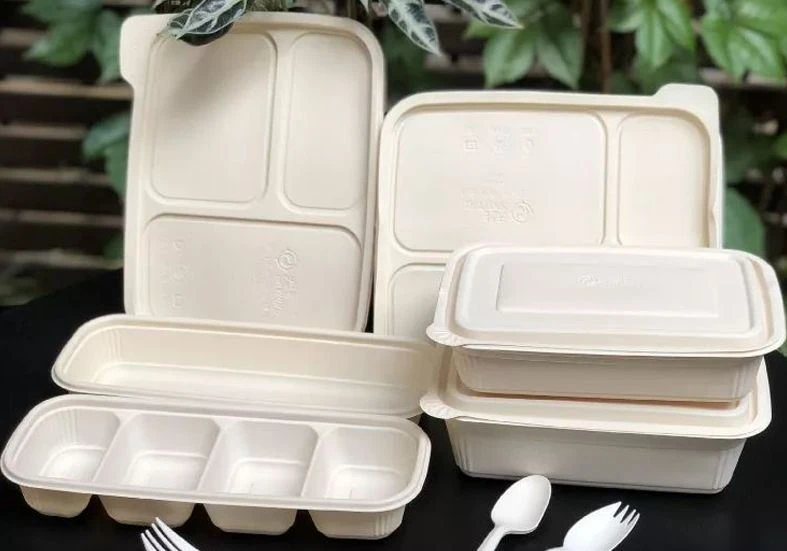
Degradable lunch boxes generally refer to food containers made of degradable plastic, degradable pulp, and degradable small molecule materials. Currently, more materials are used: PLA (polylactic acid), plant fiber (wheat straw pulp, sugar cane) Pulp, bamboo pulp), cornstarch-based materials.
Incomplete degradation of degradable plastics will still cause pollution. After some degradable plastic components are degraded or swallowed by microorganisms, what is left is the "skeleton". Although these plastic residues do not exist in the form of large pieces like non-degradable plastics, they only become small particles and exist in nature, which still affects the environment and soil.
The main components and advantages of the disposable degradable pulp molded lunch box:
(1) The raw materials are waste paper pulp or renewable straw fibers such as wheat, reed, straw, bamboo, sugar cane, palm, etc., with a wide range of sources, low prices, and no wood at all.
(2) There is no wastewater generated during the production process and no discharge.
(3) The product is waterproof and oil-proof.
(4) It can be frozen or refrigerated during use, heated in a microwave oven, and baked at 220 degrees.
(5) The product can be completely degraded in 45-90 days under natural conditions and can be composted at home. After degradation, the main component is organic matter, which will not produce any garbage residue and pollution.
(6) As a packaging container, it has the characteristics of cushioning, pressure resistance, shock resistance, etc., which can effectively protect the packaged product.
(7) The packaging of electronic products will not generate static electricity.