

Biodegradable plastics are advertised as one of the solutions to the plastic pollution problem that plagues the world, but today’s "compostable" plastic bags, tableware and cup lids will not decompose during a typical composting process, and will pollute other recyclables. Plastics cause trouble for recyclers. Most compostable plastics are mainly made of polyester called polylactic acid (PLA), which is eventually landfilled, and its life span is as long as permanent plastics.
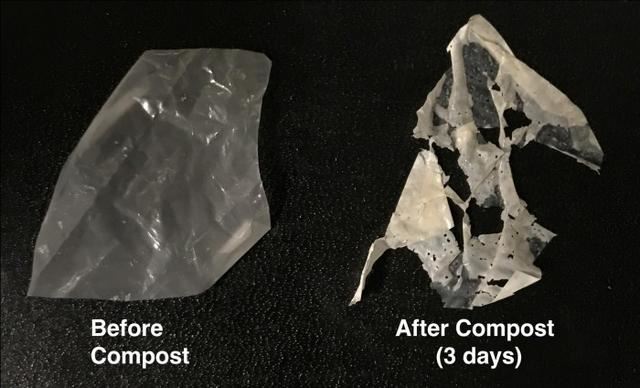
Scientists at the University of California, Berkeley have now invented a method to make these compostable plastics easier to decompose. They can be decomposed within a few weeks with only heating and water, solving a problem that has puzzled the plastics industry and environmentalists. Ting Xu, a professor in the Department of Materials Science and Engineering and the Department of Chemistry at the University of California, Berkeley, said: "People are now ready to switch to using biodegradable polymers to treat single-use plastics, but if it turns out that it causes more problems than it is worth, Then the policy may be regressed, and now, we can solve the continuing problem of non-biodegradable disposable plastics." Xu is the senior author of a paper describing this process, which will appear in this week’s journal Nature.
Theoretically, this new technology should be applicable to other types of polyester plastics, and may be able to create compostable plastic containers. These containers are currently made of polyethylene, a polyolefin that does not degrade. Xu believes that polyolefin plastics are best converted into higher-value products rather than compost. He is studying how to convert recycled polyolefin plastics into reuse.
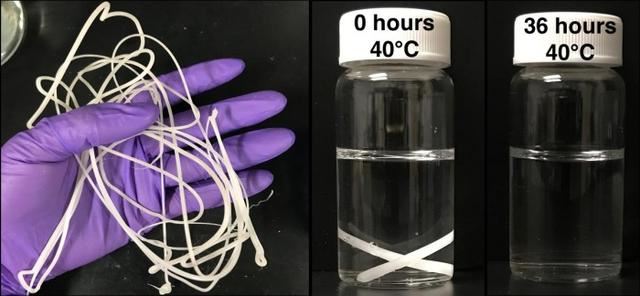
The new process involves embedding polyester-eating enzymes in the plastic manufacturing process. These enzymes are protected by a simple polymer coating to prevent the enzymes from being unwound and rendered useless. When exposed to heat and water, the enzyme gets rid of its polymer package and begins to decompose the plastic polymer into its component parts. In the case of polylactic acid, it is reduced to lactic acid, which can be soil microorganisms in the compost. Provide nutrition. The polymer coating will also be degraded.
This process eliminates microplastics, which are by-products of many chemical degradation processes and are themselves a pollutant. Up to 98% of plastics made using Xu's technology will degrade into small molecules. One of the co-authors of the study, Aaron Hall, a former PhD student at the University of California, Berkeley, has established a company to further develop these biodegradable plastics.
Plastics are designed to not be decomposed during normal use, but this also means that they will not be decomposed after being discarded. The most durable plastic has a molecular structure that is almost crystal-like. The polymer fibers are arranged so tightly that water cannot penetrate them, not to mention the microorganisms that may crush the polymer, which is an organic molecule.
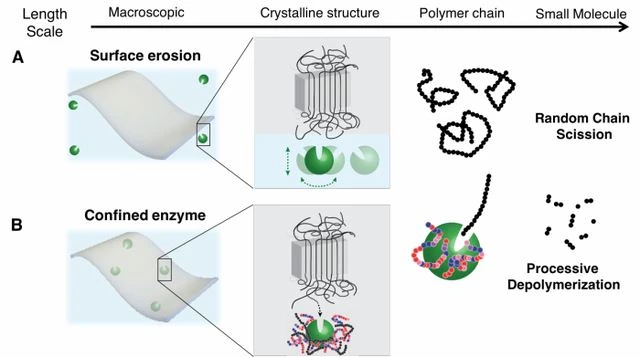
Enzymes such as lipase (green ball) can degrade plastic polymers from the surface. But they cut the polymer chain at will, leaving behind microplastics. A team at the University of California, Berkeley embedded enzymes throughout the plastic, protected by nanoclusters. The embedded enzyme is fixed near the end of the polymer chain and degrades polymer molecules from the end under proper heat and moisture conditions. This technology retains the integrity of the plastic during use, but when the user triggers depolymerization, the plastic will always become a recyclable small molecule by-product.
