

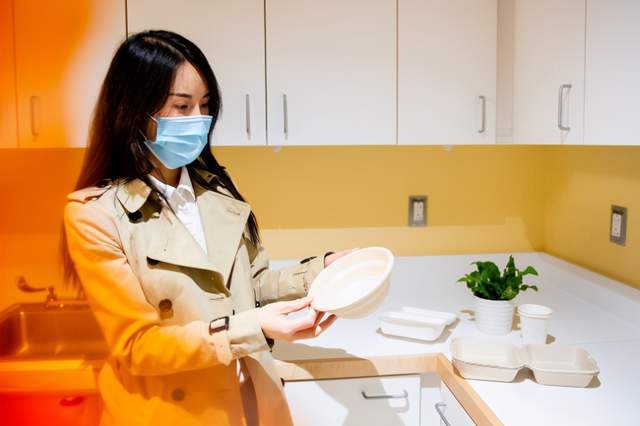
"Matter" magazine recently published an article that scientists have designed a "green" tableware made of bagasse and bamboo. This tableware does not "sacrifice" convenience and functionality, and can be used as a substitute for plastic cups and other disposable plastic containers.
Traditional plastics (or biodegradable polymers) have a degradation time of up to 450 years (or require high temperatures), and this non-toxic, environmentally friendly material can be degraded in only 60 days.
In the new study, Hongli Zhu, a researcher from Northeastern University in the United States, turned his attention to bamboo and bagasse (one of the most "high-yielding" wastes in the food industry). The long and thin bamboo fibers and the short and thick bagasse fibers are entangled together to form a tight network structure.
Containers made of these two mixed fiber materials are not only as strong and durable as plastic, but also cleaner than biodegradable materials made of recyclable materials that cannot be completely deinked. It will begin to decompose when placed in the soil for 30 to 45 days, and will be completely deformed after 60 days.
"Making food containers is very challenging. Biodegradability is not the only indicator." Zhu said, "On the one hand, we need to ensure the food safety of the material, on the other hand, the material also needs to have good wet mechanical strength and Cleanliness. It can only be used to hold hot drinks and hot food if it meets this series of conditions."
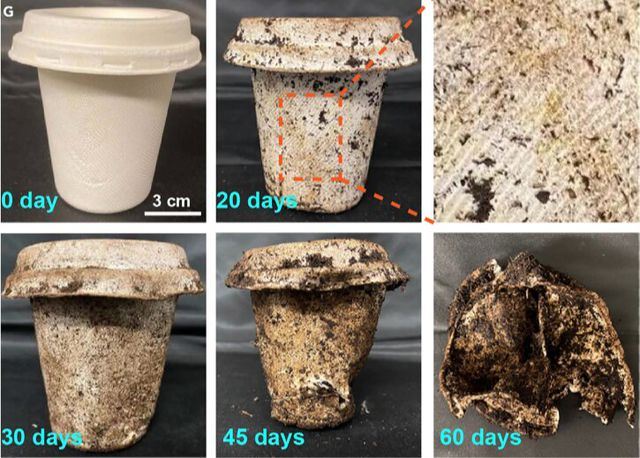
Decomposition of degradable cups (0~60 days)
The researchers added alkyl ketene dimer (AKD) to the new tableware. AKD is an environmentally friendly chemical substance widely used in the food industry. It can not only enhance the oil resistance and water resistance of the material, but also ensure the robustness of the material under humid conditions.
Researchers found that after adding AKD, the mechanical strength, grease resistance and non-toxicity of the bamboo-bagasse tableware are better than commercial degradable food containers. Moreover, the new tableware has another significant advantage: a smaller carbon footprint. The carbon dioxide emitted during the manufacturing process is 97% less than that of commercially available plastic containers and 65% less than paper products and biodegradable plastics.
The researchers' next goal is to improve the energy efficiency of the manufacturing process and further reduce costs-although the cost of making cups with new materials (2333 USD/ton) is only about half of the biodegradable plastic (4750 USD/ton) One, but still slightly higher than the traditional plastic cup (2177 US dollars / ton).
"It is difficult to ban people from using disposable tableware because it is really cheap and convenient." Zhu said, "But I believe that making these products with sustainable biodegradable materials is one of the better solutions."
发送